
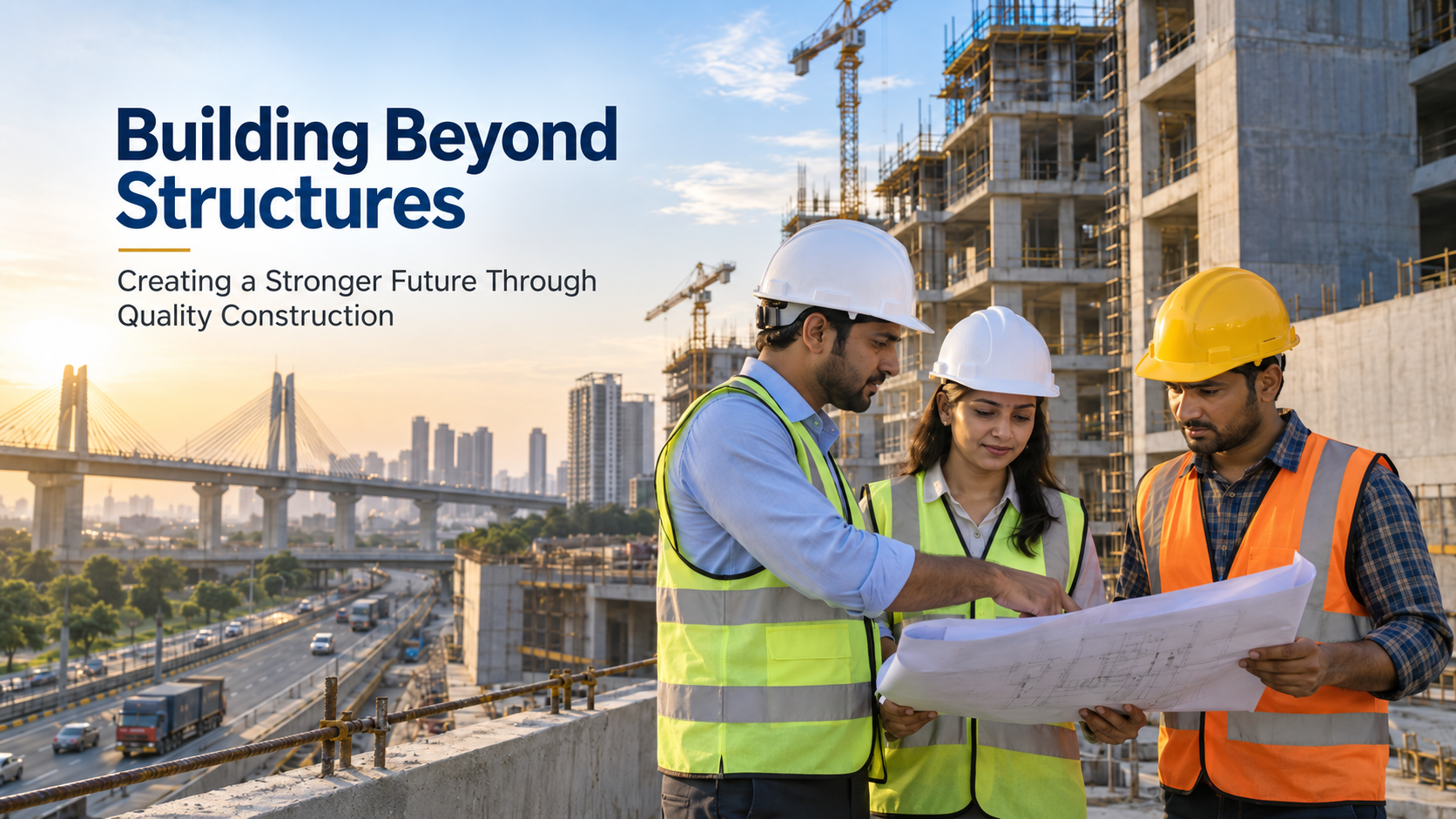
Every structure begins with a purpose.
A building creates spaces for people to live, work, and grow. A road connects communities and businesses. A bridge brings people and places closer. Infrastructure forms the foundation of economic development and plays an important role in improving everyday life.
But successful construction is not simply about completing a structure. It is about creating something that is safe, reliable, functional, and built to perform for years to come.
At Repplen Projects Private Limited, we believe construction should go beyond delivering physical structures. It should create lasting value through quality workmanship, engineering excellence, safety, innovation, responsible execution, and effective project management.
Construction That Creates Long-Term Value
The construction industry plays a vital role in shaping cities, industries, and communities. From residential and commercial buildings to roads, highways, bridges, and large infrastructure projects, every development contributes to economic and social progress.
However, every project comes with its own challenges.
Site conditions, design requirements, material specifications, project timelines, budgets, safety standards, and coordination between multiple teams must be managed carefully.
A successful construction project therefore requires more than manpower and materials. It requires careful planning, technical expertise, experienced professionals, clear communication, and disciplined execution.
When these elements come together, projects can achieve better quality, greater efficiency, and stronger long-term performance.
Quality Begins Before Construction
Quality cannot be added at the final stage of a project. It must begin during planning and continue throughout the entire construction process.
Understanding drawings, specifications, site conditions, material requirements, and construction methods allows project teams to identify potential challenges before they affect progress.
Material quality is equally important. Materials must be carefully selected, tested, handled, and installed according to approved specifications.
Workmanship must also be continuously monitored. Regular inspections and quality checks help identify issues at an early stage and reduce unnecessary rework.
When quality becomes part of the working culture, it creates better outcomes not only for clients but also for project teams and the people who ultimately use the structures.
Engineering Excellence Behind Every Structure
Engineering is the foundation of successful construction.
A structure must not only look good; it must perform safely under the conditions for which it was designed. Structural engineering ensures that buildings and infrastructure can withstand different loads, environmental conditions, and long-term usage requirements.
Modern construction also requires coordination between multiple disciplines. Civil, structural, mechanical, electrical, plumbing, architectural, and project-management teams must work together throughout the project.
Effective coordination reduces conflicts during execution and improves overall project efficiency.
Technology is further transforming the way construction projects are planned and managed. Digital drawings, modelling tools, project-management platforms, and data-driven monitoring can help teams identify challenges earlier and make informed decisions.
However, technology delivers its greatest value when combined with strong engineering knowledge and practical site experience.
Buildings Designed for People
Buildings are more than concrete, steel, walls, and finishes.
They are spaces where people live, work, interact, and build their future.
Residential projects require thoughtful planning, functionality, comfort, durability, and safety. Commercial buildings must address business requirements while providing efficient spaces, essential services, accessibility, and flexibility for future needs.
The construction stage is where design concepts become reality.
Every activity must be executed in the right sequence and carefully coordinated with other works. Even small execution errors can affect finishes, building services, maintenance, and the overall user experience.
Effective project management and strong site supervision help ensure that the completed building reflects both the original design vision and the practical requirements of its users.
Roads and Highways That Connect Growth
Transportation infrastructure is an essential part of development.
Roads and highways connect cities, industries, markets, workplaces, schools, healthcare facilities, and communities. They support the movement of people and goods and strengthen regional economic activity.
Highway construction involves several critical activities, including:
- Earthworks
- Drainage systems
- Pavement construction
- Road geometry
- Safety measures
- Traffic management
- Quality control
These projects must be designed and executed to withstand continuous vehicle movement, changing weather conditions, and long-term usage.
Strong construction methods and quality control contribute to better durability and performance.
Well-developed roads do more than reduce travel time. They improve accessibility, strengthen logistics networks, encourage regional development, and create new opportunities for economic growth.
Bridges That Build Connections
Bridges are among the clearest examples of engineering and construction working together.
Their purpose may appear simple — creating a safe connection across a physical obstacle — but the process behind a successful bridge requires detailed planning and engineering.
Foundation conditions, structural loads, construction methodology, safety requirements, environmental considerations, and long-term durability must all be carefully evaluated.
Bridge construction also demands precision during foundation work, structural construction, lifting operations, temporary works, and final execution.
A completed bridge is more than a construction achievement. It becomes part of everyday life for thousands of people and can serve communities for generations.
Safety Must Always Come First
Construction sites are dynamic environments involving machinery, equipment, materials, excavation, lifting activities, electrical systems, and work at height.
Without proper safety practices, these activities can create significant risks.
That is why safety must remain a fundamental priority throughout every project.
Training, personal protective equipment, risk assessments, safe working methods, site supervision, proper housekeeping, and clear communication all contribute to a safer working environment.
More importantly, safety must become part of the everyday behaviour of everyone involved in a project.
A strong safety culture protects people while also supporting disciplined and efficient execution.
No deadline or project milestone should ever be more important than the safety of the people working to achieve it.
Sustainable Construction for the Future
The future of construction must also consider sustainability.
Responsible construction is not limited to using environmentally friendly materials. It includes reducing material waste, improving resource utilisation, managing water and energy responsibly, minimising unnecessary rework, and considering the long-term performance of completed structures.
Good planning itself can contribute to sustainability.
When projects are properly coordinated, materials can be used more efficiently and construction activities can be managed with less waste.
Sustainable construction is ultimately about making better decisions today so that buildings and infrastructure can continue delivering value tomorrow.
Project Management Makes the Difference
Large construction projects involve numerous teams, activities, materials, approvals, and deadlines.
Without effective coordination, even a technically strong project can experience delays, inefficiencies, and unnecessary costs.
Effective project management brings all these elements together.
Planning defines the sequence of activities. Progress monitoring helps identify delays and enables corrective action. Procurement planning ensures that materials are available when required.
Regular coordination between clients, consultants, contractors, vendors, and subcontractors helps resolve issues efficiently.
The objective should always be to identify challenges before they become major problems.
A proactive approach to project management improves predictability, communication, efficiency, and overall project performance.
Building Through Collaboration and Trust
Construction is always a collaborative effort.
Clients, architects, consultants, engineers, contractors, suppliers, subcontractors, and site teams must work toward a common objective.
Strong collaboration requires transparent communication, clearly defined responsibilities, accountability, and mutual respect.
Trust develops when commitments are respected and performance remains consistent.
For a construction company, technical knowledge is essential. But technical capability becomes even more valuable when supported by integrity, teamwork, accountability, and a strong focus on clients.
These principles help build stronger professional relationships and better project outcomes.
Building More Than Projects
The structures created today will influence how people live, work, travel, and connect for many years.
This gives the construction industry a responsibility that extends far beyond project completion.
At Repplen Projects Private Limited, our focus is on delivering construction and infrastructure solutions with quality, safety, engineering discipline, innovation, sustainability, and client satisfaction at the core.
Across buildings, structural engineering, roads, highways, bridges, and other infrastructure works, our objective remains the same:
To create reliable structures that are built with purpose and built to last.
The future of construction will continue to evolve with new technologies, new expectations, and increasingly complex projects.
But some fundamentals will always remain important — quality, safety, integrity, collaboration, and strong execution.
Because great construction is not only about what we build today.
It is about the value we create for tomorrow.
Leave a Reply